Why can LASIK produce poor results?
LASIK works by using a laser to permanently reshape the corneal tissue, flattening it to reduce short-sightedness or steepening it for long-sightedness. The procedure itself is precise, the problems usually arise from either (a) the cornea responding in an unexpected way, (b) the patient being on the edge of the safe treatment range, or (c) an underlying corneal weakness that wasn't detected pre-operatively.
Post-LASIK regression
Some patients see clearly for a year or two after LASIK, then notice their vision gradually worsening again. This is called regression: the cornea hasn't maintained the new shape, and the refractive error is returning. Regression is more common in patients with higher original prescriptions and thinner corneas. Glasses or contact lenses can manage regression, though fitting lenses on a post-LASIK cornea requires specialist experience because the corneal profile is unusual.
Post-LASIK ectasia, the more serious complication
Ectasia is a progressive thinning and bulging of the cornea, essentially iatrogenic keratoconus triggered by the LASIK procedure. It occurs when too much corneal tissue has been removed, leaving insufficient structural integrity. The cornea progressively weakens and distorts, causing worsening, irregular vision that neither glasses nor standard lenses can adequately correct. Enhancement (repeat LASIK) is not possible with ectasia; the cornea is already compromised.
Persistent blur, glare, and halos
Some patients have objectively good acuity on a chart but complain of poor vision quality, starbursts around lights, ghosting, reduced contrast at night. This often relates to the optical zone of the treatment being too small relative to the patient's pupil size in low light, or to dry eye induced by the procedure (LASIK severs corneal nerves that are responsible for tear production). These symptoms sometimes resolve over 6–12 months as the nerves regenerate; in other cases they are persistent.
Can scleral lenses help post-LASIK patients?
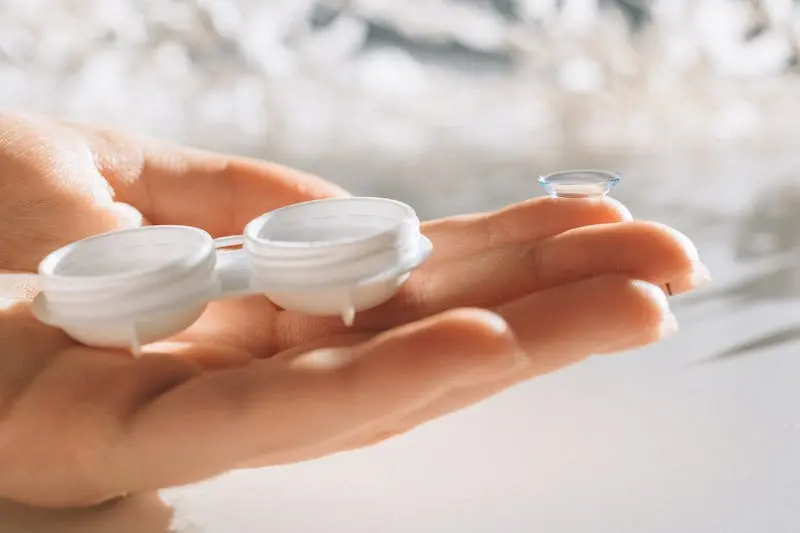
Yes, scleral lenses are arguably the single most effective intervention for patients with post-LASIK ectasia or significant optical irregularity. Unlike glasses or soft lenses, scleral lenses rest on the white of the eye (the sclera) and vault completely over the cornea. This creates a smooth, regular optical surface over the irregular post-surgical cornea, and the fluid reservoir between the lens and the cornea addresses post-LASIK dry eye simultaneously. Many patients who were told 'there is nothing more that can be done' regain functional, stable vision with scleral lenses.
What about a second surgery?
A repeat ablation (enhancement) is sometimes possible for simple regression with adequate remaining corneal thickness, and only after confirming the cornea is stable. For ectasia, further surgery is generally contraindicated, the priority is corneal stabilisation (crosslinking) followed by non-surgical vision rehabilitation with specialty lenses. Any decision about further surgery should involve a second opinion from a corneal specialist.
Post-LASIK care at Second Sight, Jaipur
Dr. Ashima Bhargava has significant experience fitting specialty lenses on post-LASIK and post-RK corneas, which have an unusual curvature profile that requires specialist fitting skills. We use detailed corneal topography to design scleral or custom RGP lenses that match the exact post-surgical shape. If you have been told 'nothing more can be done' after LASIK, or if your vision has been deteriorating since your procedure, a specialist assessment is worthwhile before accepting that outcome as permanent.
Book a Free Eye Test →